
Where We Have Been - New Zealand - Northland
We won the lottery just by being born—and getting to live—in a stunning part of New Zealand: Taranaki, with the majestic Mount Taranaki (Mount Egmont) presiding over everything. It’s one of those places where you really can ski on the mountain in the morning and finish the day watching the sun drop over world-class surf breaks in the afternoon.
We’ve explored pretty much all of our beautiful home country, from Cape Reinga in the far north to Milford Sound in the far south (David has even dived with the Great Whites off Stewart Island).
As we’ve travelled so widely around our home country, we’ll cover New Zealand region by region, sharing what we consider some of the highlights.
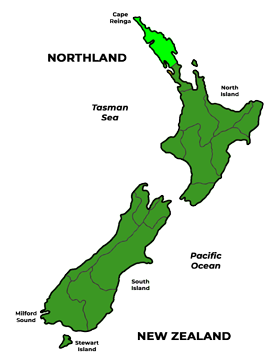
Working our way south from the very top of New Zealand, the first place that really earns its spot on the highlights list is Cape Reinga.
Sitting at the tip of the North Island, Cape Reinga is often described as the meeting point of the Tasman Sea to the west and the Pacific Ocean to the east. From the lighthouse you can watch the tidal race where the two seas collide, creating restless, swirling water just offshore.
In Māori mythology, the cape is also believed to be the point where the spirits of the dead enter the underworld by jumping into the sea to return to Hawaiki, the homeland of their ancestors—Reinga being the Māori word for underworld.
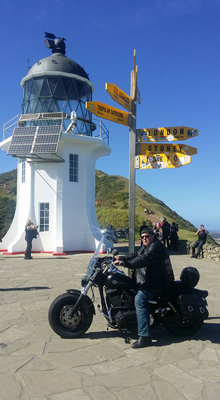
D On his Harley @ Cape Reinga Lighthouse
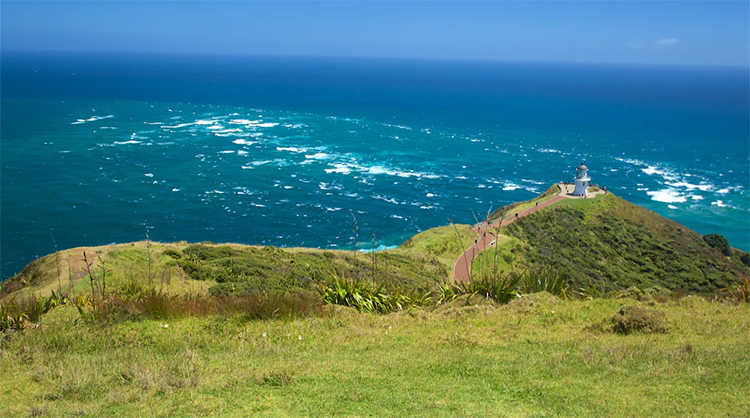
Cape Reinga, with the white water marking where the Tasman Sea and the Pacific Ocean come together
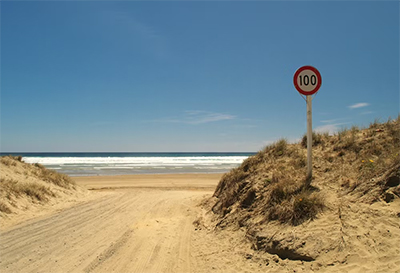
Entry to Ninety Mile Beach: yes, it’s signposted at 100 kph
because it’s officially considered a road
so ensure you follow the road rules.
As you travel south towards Kaitaia, the first town of any size, you have the option of sticking to the sealed road or taking a less formal route down Ninety Mile Beach (misnamed, as it’s really only about 55 miles long). For those less adventurous, there are tourist operators who will handle the driving for you.
Do be careful though—many a traveller has found their drive along the beach ending unhappily, either by getting bogged in soft sand (often with the incoming tide beating the vehicle recovery professionals), or by rolling a vehicle when turning too sharply and the wheels dig into the soft sand.
The Karikari Peninsula is another highlight of Northland. In fact, for a number of years we owned a section at Whatuwhiwhi with fantastic views down Tokerau Beach, and we even had an architect design our retirement home for it.
While the peninsula is relatively remote, it has what we consider one of—if not the—most spectacular beaches in New Zealand: Maitai Bay (formerly Matai Bay), where there’s also a Department of Conservation (DOC) campsite.
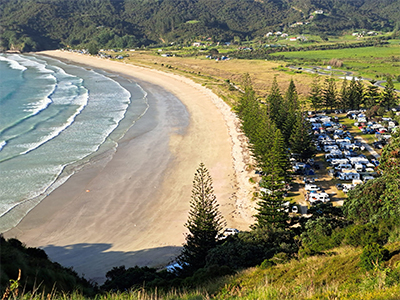
View down Tokerau Beach from our section
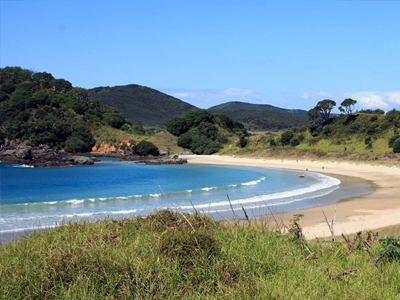
Maitai Bay
The Bay of Islands is one of those parts of New Zealand that’s famous for good reason—both for its natural beauty and its historical significance. With stunning beaches, the islands (including the Hole in the Rock), big game fishing and plenty more, it’s an incredibly popular destination.
For us, though, Russell is the standout. With its historic buildings and ties going back to 1843—and with New Zealand’s first capital (1840–1841) having been nearby at Old Russell (Okiato)—it has a real sense of place. The town just feels good to be in, helped along by its beautiful setting, the pōhutukawa-lined waterfront, and the old Russell hotel, the Duke of Marlborough, which has hosted guests since 1827.
If you want a cheap way to experience the views from the water, there are a couple of good options. One is the passenger ferry between Russell and Paihia, and another is the car ferry from just out of Russell at Old Russell (Okiato) to Opua, just south of Paihia.
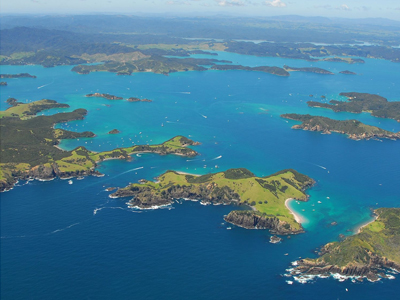
The Bay of Islands
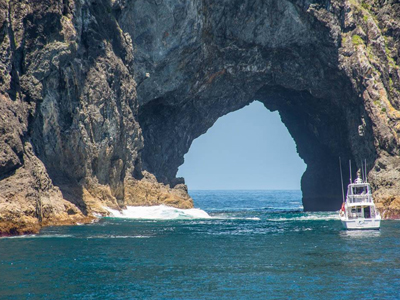
The Hole in the Rock
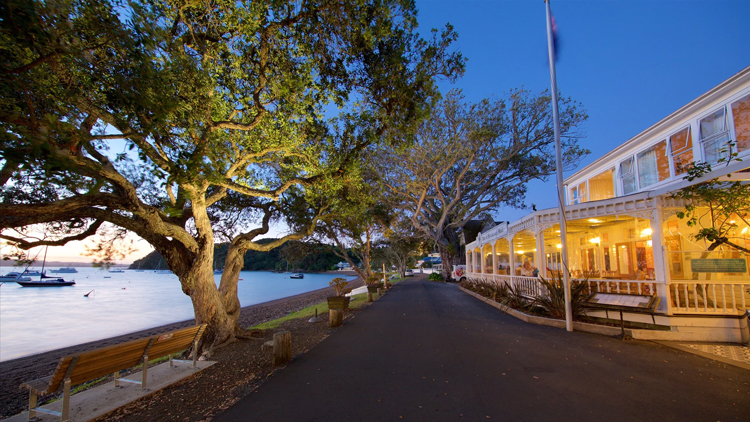
Russell Waterfront and the Duke of Marlborough
Also in the Bay of Islands are the Waitangi Treaty Grounds, where the Treaty of Waitangi between the British Crown (Queen Victoria) and Māori was signed in 1840. The Treaty is hugely significant to New Zealand’s history and remains a key part of our national identity.
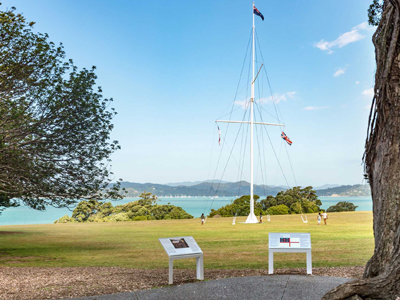
The Waitangi Treaty Grounds
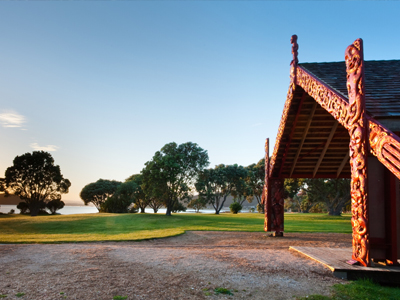
The Waitangi Treaty Grounds
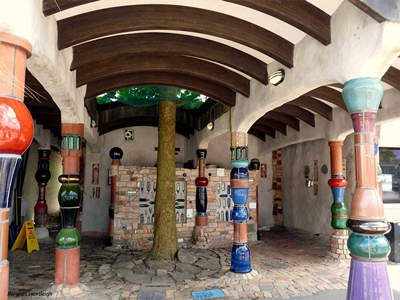
The Hundertwasser Toilets
Located in the small town of Kawakawa is one of the few toilet blocks worldwide that’s seen as both an international work of art and a tourist attraction in its own right.
The Hundertwasser Toilets are a public toilet block completed in 1999, named after the architect and visual artist Friedensreich Hundertwasser, who conceived and designed the project. It’s definitely worth a stop to have a look around (and, yes, to use the facilities!).
One of our other favourite spots in Northland is the Hokianga and the neighbouring area. A long time ago we even seriously considered buying the local general store, and it was during a visit to check it out that we had one of those genuinely magical moments. A pod of orcas was in the harbour, and they passed incredibly close to where we were standing on the small jetty at Opononi, made famous in the mid 1950’s by the exploits of a bottlenose dolphin called Opo.
It was partly through considering the general store that we were introduced to Akitas. We’d been thinking about a second dog and, given our plans at the time, decided a larger breed with some natural guard tendencies was what we needed. After considering many breed options, that’s how Quin joined our family. One of those life events that truly changed us.
On the way to the Hokianga, it’s worth choosing the route that includes the Rawene ferry for a short crossing of the upper harbour—one of those little detours that makes the journey feel like part of the experience.
To the south is the Waipoua Forest, home to the largest known kauri tree in New Zealand, Tāne Mahuta, estimated to be more than 1,250 years old. It’s a beautiful drive through the forest, and stopping to see Tāne Mahuta is well worth it—an easy short walk for something that feels properly awe-inspiring when you finally stand in front of it.
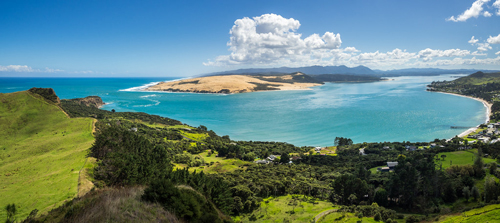
The Hokianga Harbour
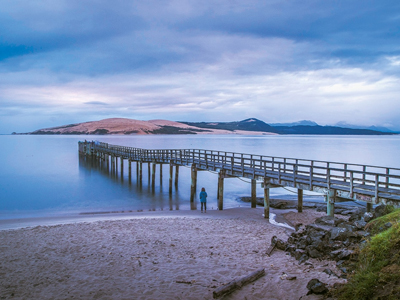
The Opononi Jetty
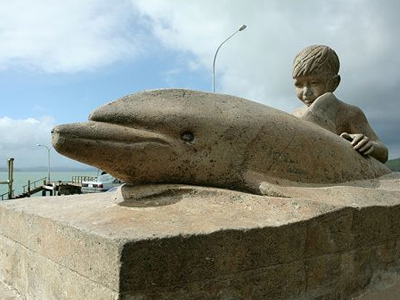
Opo the Dolphin and Friend @ Opononi
There’s so much more to experience in Northland, including places like Waipu/Waipu Cove, Langs Beach, and Mangawhai/Mangawhai Heads in the south-east corner of the region. And many of the reasonably isolated bays further north along the eastern coast are well worth seeking out too—places like Taupo Bay, Helena Bay, Ōakura and Whangaruru and Matapouri Bay, to name just a few.
All of them have stunning beaches and scenery, and in many cases you’ll find even more islands dotted just offshore.
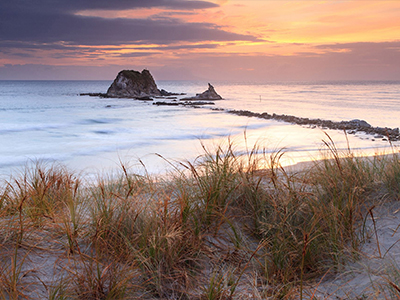
Mangawhai Heads at Sunset
Closing Thought: Northland is well worth the effort if beaches and scenery are your thing.
We’ve been lucky over the years to travel more than many—though nowhere near as much as we still aspire to. The world is a big place, and there are so many destinations left to discover: places we haven’t seen yet, places we want to explore more thoroughly, and old favourites we can’t wait to reconnect with.
Elsewhere on Crows on the Go, you’ll find:
• more about our travels and the places we’ve been
• our thoughts (and, in some cases, tips) on those destinations
• the places that have become “special” to us
• and more!