
David's Special Places
Here are a few of the places that David considers special. For some of them the reason is obvious for others the reason is quite simply that something about them touched his soul. They are listed in alphabetical order.
The story of the Alamo is well worth digging into. In 1836, a relatively small band of Texian defenders—around 200 men, many of them volunteers—reportedly ignoring their commanding officer’s advice to abandon their position and instead choosing to stand their ground, held out for nearly two weeks against a much larger, supposedly 1,500 or so, Mexican force, supposedly 1,500 or so, under Santa Anna before the mission was finally overrun. Legends of Texas and the American frontier are forever tied to that siege, including William B. Travis, James Bonham, James “Jim” Bowie and David “Davy” Crockett.
Crockett is the personal “connection” for David. As a kid, he remembers dressing up as Davy Crockett for a school fancy-dress day—complete with a coonskin cap (a possum version in David’s case)—and being called “Crockett” by his father when he was young.
And, of course, there’s the larger-than-life mythology: Davy Crockett, the “King of the Wild Frontier.”

The Battle at the Alamo

David & Davy Crockett @ The Alamo
As the site of a battle that reportedly lasted less than an hour, Culloden is widely seen as the point where traditional Scottish Highland life effectively ended. With an estimated 1,500–2,000 dead or injured on the Scottish side, compared with around 200 for the British, it was an overwhelming defeat—and it effectively spelled the end of the Jacobite uprising.
This open field in the Scottish Highlands, near Inverness, is a powerfully moving place.
And for David, there’s a personal connection too: while his mother was “British,” her lineage included the Frasers.

Clan Fraser Grave @ Culloden

The Culloden Memorial
It feels a little disingenuous to label a concentration camp as a “special place”—especially Dachau, opened in March 1933 as the first regular Nazi concentration camp. But I do beg to differ. If you walk through those gates and come away untouched, then (to me) something essential has gone missing—you need to take a long, honest look inward and rediscover your humanity.
On our visit I carried a camera, and to this day I can’t explain why I never once felt compelled to lift it to my eye. I’ve been to other places where terrible crimes were committed—a Stalin era mass grave near Ekaterinburg and other places where many people lost their lives including The Alamo, Culloden, Gallipoli and the 9 11 Memorial. None of them come close to Dachau, or to the particular kind of evil that was made ordinary there.
One bright point I do hold onto is our young tour guide. It was just Carolyn and me, plus three others who didn’t speak English—so, in effect, we had him to ourselves. He spoke candidly about how young Germans are encouraged to learn about what happened, with the aim of ensuring it never happens again. Sadly, the modern world can sometimes seem more interested in editing—or even deleting—uncomfortable history than in facing it, learning from it, and doing better.
‘Those who cannot remember the past are condemned to repeat it’
George Santayana
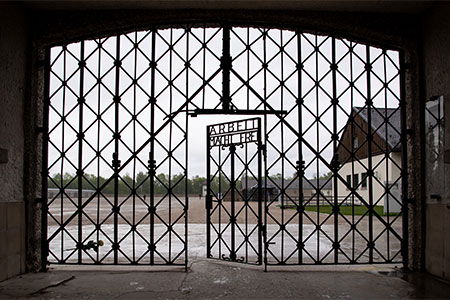
Work Makes One Free
Turkey itself is a pretty amazing place, and the way the Turks embrace Kiwis—given that we tried to invade them during WWI—is truly something to experience. Gallipoli is where Australian and New Zealand (ANZAC) troops landed, and where many lost their lives, at what became known as Anzac Cove on 25 April 1915. It was a campaign doomed to eventually fail, yet one that many believe marked the beginning of New Zealand’s march toward independence.
ANZAC Day, observed each year on 25 April, is a national day of commemoration not only in Australia and New Zealand, but also recognised in Turkey and the United Kingdom. At dawn, thousands gather to remember those who were killed in war and to honour returned and serving servicemen and women.
They shall grow not old, as we that are left grow old;
Age shall not weary them, nor the years condemn.
At the going down of the sun and in the morning
We will remember them.
David, Carolyn, David’s father, and David’s brother met in Istanbul, then travelled together to Gallipoli to fulfil one of David’s father’s bucket-list items. As a returned serviceman in the Royal New Zealand Air Force, and as an RSA President and Life Member, he had a deeply personal connection to Gallipoli. But he was also there for another reason: he was documenting the lives of men from his hometown who had been killed and buried—not only at Gallipoli, but at other sites across Europe as well.
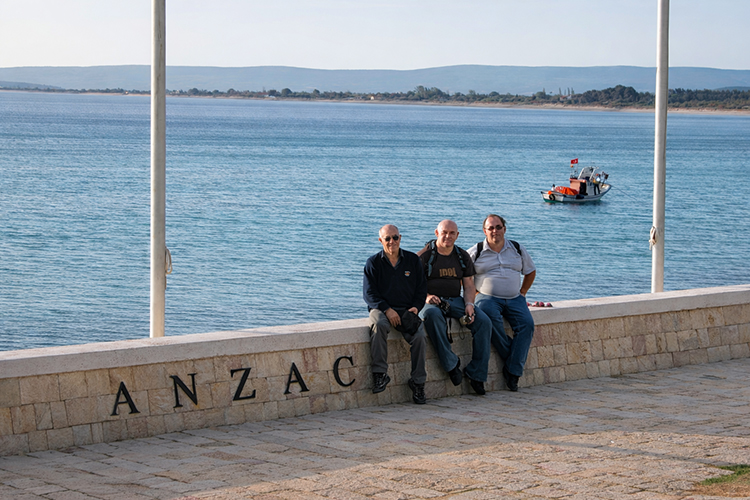
Peter (David’s dad), Steve (David’s brother) and David @ Anzac Memorial
Once the ANZACs landed and began trying to push inland, they moved through an area that became known as Shrapnel Gulley. It was there, on a fine day, that David found himself standing on a small rise, looking across at his brother on another, his father further up Shrapnel Gulley, and Carolyn further down. He still vividly remembers the moment the mana of the place seemed to engulf him, holding him still for several long minutes.
War brings out the worst and the best in people. Great things can come from adversity. Engraved forever at Anzac Cove (see image below) are these words from Kemal Ataturk—Commander of the Turkish 19th Division during the Gallipoli Campaign, and later the first President of the Turkish Republic (1923–1938):
Those heroes that shed their blood and lost their lives. You are now living in the soil of a friendly country therefore rest in peace. There is no difference between the Johnnies and the Mehmets to us where they lie side by side here in this country of ours. You, the mothers, who sent their sons from faraway countries wipe away your tears; your sons are now lying in our bosom and are in peace. After having lost their lives on this land they have become our sons as well.
Likewise, there’s the monument depicting a Turkish soldier carefully carrying a wounded ANZAC in his arms—a powerful symbol of compassion amid the brutality of war. The story goes that:
After another unsuccessful offensive, when both sides fell silent to prepare for the next battle, only rare random shots came from the trenches. Meanwhile, a wounded Australian soldier was left lying in no man’s land. He moaned and called out to his comrades, but in vain: none of the Australian soldiers, of course, would have dared to approach him to become a live target for the enemy.
Suddenly, the shooting from the side of the Turkish troops stopped, and a fighter with a white flag rose from the trench (for this, he used his shirt). Then, in complete silence, the Turkish soldier approached the wounded man, carefully raised him, carried him to the enemy trenches, and then returned to his own, after which the battle continued.
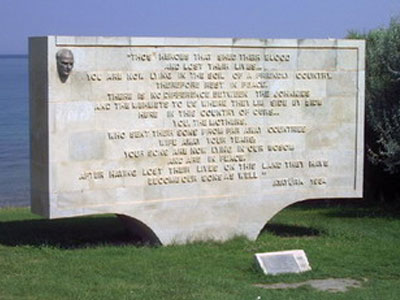
The Ataturk Memorial at Anzac Cove
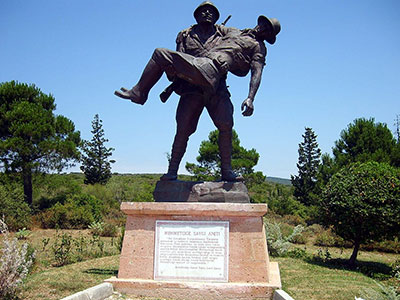
Respect to Mehmetçik Monument
During his motorcycle trip across Russia, David ended up spending a few days in Moscow after his brother landed in hospital. Once he’d made sure he was okay, David caught the underground—famous for its grand, historic stations—into the city centre. Exiting via a side alleyway, he suddenly emerged into Red Square, confronted by the imposing walls of the Kremlin and the unmistakable colours and shapes of Saint Basil’s Cathedral.
Part of the impact is undoubtedly the history of the place, but it’s also tied to how often the Kremlin—and everything associated with it—has featured in the novels and films David has enjoyed over the years. That blend of lived history and cultural mythology makes the moment of stepping into Red Square feel especially powerful.
David returned another day to enjoy a slower, more contemplative walk around the high walls that completely encircle the Kremlin, taking in the scale and gravity of the place at a more measured pace.
Tip: If you ever end up in hospital in Moscow, make sure you have someone who can bring you soap and toilet paper—both are surprisingly rare commodities.
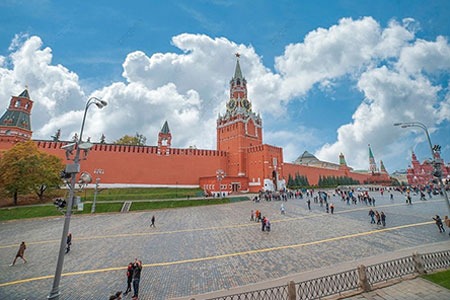
Red Square and The Kremlin
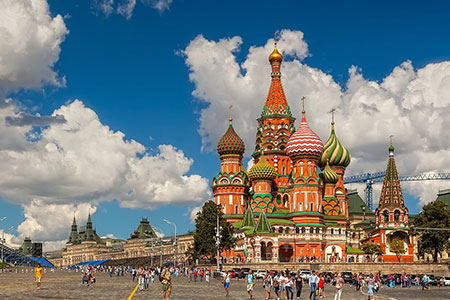
Cathedral of St. Basil the Blessed
Uluru is a deeply spiritual place for the Aṉangu, the Traditional Owners, and for many Aboriginal Australians more broadly. Carolyn and David spent time there, and David still vividly remembers a predawn visit—sitting quietly as the sun rose, the rock slowly shifting colour, and an overwhelming sense of calm settling over them.

D relaxing @ Uluru

C & D @ Uluru
We’ve been lucky over the years to travel more than many—though nowhere near as much as we still aspire to. The world is a big place, and there are so many destinations left to discover: places we haven’t seen yet, places we want to explore more thoroughly, and old favourites we can’t wait to reconnect with.
Elsewhere on Crows on the Go, you’ll find:
• more about our travels and the places we’ve been
• our thoughts (and, in some cases, tips) on those destinations
• the places that have become “special” to us
• and more!