
David's Obelisks
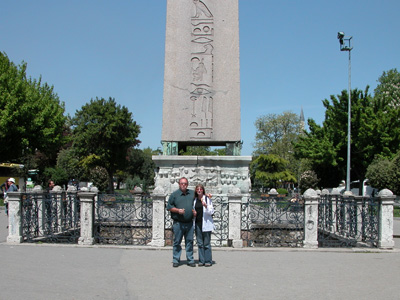
D & C @ The Obelisk of Theodosius, Istanbul
David has developed a bit of a thing for obelisks during our travels. It’s a mix of things, really: their majestic symmetry; the way some are covered in intricate hieroglyphs or relief carving; their sheer age and the weight of history they carry. And then there’s the part that’s harder to ignore once you start noticing them—the simple fact of how many have been relocated, and the cultural appropriation and power dynamics that often sit behind why they’re standing in one country when they originated in another.
Once David started paying attention, he began spotting them everywhere—almost like a travel scavenger hunt. He’s delighted in finding them in all sorts of places: Istanbul, London, New York, Paris, Rome, and even Vatican City. It’s become one of those quirky “David things” that now feels like part of the fun: walk into a square, glance around, and see if there’s an obelisk quietly anchoring the scene.
Istanbul – Obelisk of Theodosius
The Obelisk of Theodosius in Istanbul is, in fact, an ancient Egyptian obelisk commissioned by Pharaoh Thutmose III (18th Dynasty, 15th century BCE). It was originally erected at Karnak (near modern Luxor), covered in hieroglyphs celebrating the pharaoh and his victories.
Centuries later, it began its second life far from Egypt. The obelisk was moved in Roman times—transported to Alexandria in the 4th century—and then shipped on again to Constantinople, where Emperor Theodosius I had it re-erected in the Hippodrome in 390 AD. Today, that’s Sultanahmet Square (At Meydanı / Sultanahmet Meydanı) in the heart of Istanbul.

Obelisk of Theodosius, Istanbul
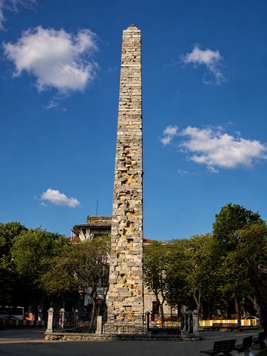
Walled Obelisk, Istanbul
Istanbul – Walled Obelisk
The Walled Obelisk (also called the Masonry Obelisk) is the other “obelisk-shaped” monument in the former Hippodrome of Constantinople, now Sultanahmet Square in Istanbul. It sits right alongside the Obelisk of Theodosius and the Serpentine Column.
Unlike the Egyptian obelisk next to it, this one isn’t a single granite monolith—it’s a stone core built up of masonry, and its exact original date is a bit murky. It’s often thought to have been constructed in late antiquity (possibly to “mirror” the nearby Obelisk of Theodosius), and it later became linked to Emperor Constantine VII Porphyrogenitus, who restored it in the 10th century and added an inscription. Back then it was even clad in gilded bronze plates, which were later stripped off during the Fourth Crusade in 1204—leaving the more bare, weathered monument as it is today
London – Cleopatra’s Needle
Cleopatra’s Needle in London is one of a pair of obelisks (together known as Cleopatra’s Needles) that were moved from the ruins of the Caesareum of Alexandria in the 19th century. The other “needle” is located in Central Park in New York.
Inscribed under Thutmose III and later Ramesses II of the Egyptian New Kingdom, the obelisk was moved to Alexandria around 12 BC, where it remained for more than 1,800 years.
It was presented to the Prince Regent in 1819 by Egypt’s ruler, Muhammad Ali, as a diplomatic gift marking British victories over the French in Egypt.

Cleopatra’s Needle, London

Cleopatra’s Needle, New York
New York – Cleopatra’s Needle
Cleopatra’s Needle in New York City is one of a pair of obelisks (together known as Cleopatra’s Needles) that were moved from the ruins of the Caesareum of Alexandria in the 19th century. The obelisk itself dates back to the 15th century BC, and it was installed in Central Park—just west of the Metropolitan Museum of Art’s main building—on 22 February 1881.
Originally erected in the Egyptian city of Heliopolis on the orders of Thutmose III (around 1475 BC), the obelisks were later moved to Alexandria. There, the Romans set them up at the Caesareum—a temple associated with Cleopatra and later Roman rule—around 13–12 BC.
Paris – Luxor Obelisk
The Luxor Obelisk sits in the centre of Place de la Concorde in Paris, where it was erected in 1836 after its long journey from Egypt. Today it stands amid bustling traffic, and the contrast is striking—an ancient monument surrounded by the glitz and movement of modern Paris.
The Luxor Obelisks (French: Obélisques de Louxor) are actually a pair of ancient Egyptian obelisks, carved more than 3,300 years ago to stand on either side of the entrance to Luxor Temple during the reign of Ramesses II (around 1250 BC). The right-hand (western) obelisk—about 23 metres high—was gifted by Egypt to France in the 1830s and relocated to Place de la Concorde. Its twin, the left-hand (eastern) obelisk, remains in its original position at Luxor.
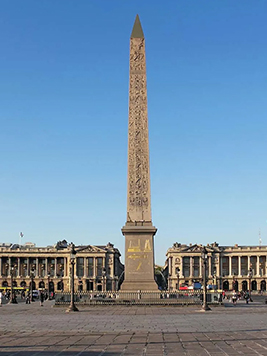
Luxor Obelisk, Paris

Flaminio Obelisk, Rome
Rome – Flaminio Obelisk
Right in the centre of Piazza del Popolo, the Flaminian Obelisk is one of Rome’s most significant—and, famously, one of the first to be brought from Egypt to the city, shipped over on Augustus’sorders in the early years of his reign (often dated to around 10 BC–1 BC).
Originally built around 1300 BC for the Temple of the Sun (Ra) at Heliopolis in Egypt, the obelisk stands 25.90 metres tall on its own and reaches 36.50 metres when you include the base and cross. It’s carved from a single block of red granite, with hieroglyphs on its sides added by order of Seti I and his son Ramesses II.
Vatican City – Vatican Obelisk
The Vatican Obelisk is an ancient Egyptian obelisk and one of the thirteen ancient obelisks of Rome, although today it stands in pride of place in St Peter’s Square in Vatican City. One of its quirks is that it’s the only ancient obelisk in Rome that’s never fallen.
It’s also unusual because it’s blank—no hieroglyphs, no royal titles. No one knows for certain whether any inscriptions were removed before it was brought to Rome, or whether it was always plain. Some sources (including Pliny) link it to Heliopolis in Egypt, and it’s said to have stood for a time in Alexandria before its journey west.
In AD 40, Emperor Caligula had it shipped to Rome and set up on the spine of the circus later known as the Circus of Nero, on the site now largely within Vatican City. Even after the circus fell out of use and the area became a necropolis, the obelisk remained standing—until it was famously moved to its current position in 1586 on the orders of Pope Sixtus V.
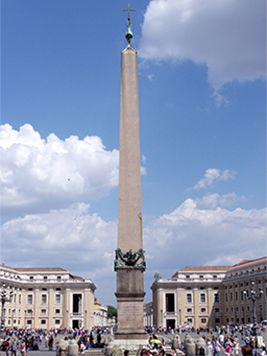
Vatican Obelisk
We’ve been lucky over the years to travel more than many—though nowhere near as much as we still aspire to. The world is a big place, and there are so many destinations left to discover: places we haven’t seen yet, places we want to explore more thoroughly, and old favourites we can’t wait to reconnect with.
Elsewhere on Crows on the Go, you’ll find:
• more about our travels and the places we’ve been
• our thoughts (and, in some cases, tips) on those destinations
• the places that have become “special” to us
• and more!